When Uniform Standards Matter More Than Leadership Standards
It’s insane how many leaders lose sleep over uniform standards—but barely glance at leadership standards.
Patches an inch too low.
Approved vs. unapproved outer carriers.
Hat on vs. hat off.
Velcro facing the “wrong” direction.
Patch changes announced with urgency—without any explanation of why.
Those emails go out fast.
Those corrections happen publicly.
Those priorities are crystal clear.
Meanwhile…
No coaching on emotional regulation
No modeling of accountability
No follow-up after hard calls
No clarity during uncertainty
And leadership wonders why morale is low, tension is high, and police officer mental health and wellness continues to decline.

The Problem Isn’t Standards
It’s which standards get enforced.
Standards matter.
Uniform standards aren’t the enemy.
The issue is imbalance.
When appearance standards are enforced relentlessly—but leadership behaviors are vague, inconsistent, or ignored—officers fill in the gaps themselves.
And what fills that gap isn’t motivation.
It’s anxiety.
This is where stress compounds, burnout accelerates, and agencies start asking why their wellness efforts “aren’t working.”

What Officers Actually Learn From This
Whether intentional or not, the message becomes:
“Looking right matters more than leading well.”
“Don’t mess up visibly—but handle stress privately.”
“Compliance is valued more than competence.”
“Image outranks impact.”
That environment doesn’t support police officer mental health and wellness.
It teaches officers to perform—not to trust.
Uniforms Don’t Build Trust - Leadership Does
Trust is built when supervisors consistently demonstrate:
Clear communication during uncertainty
Emotional regulation under pressure
Accountability without humiliation
Follow-up after critical incidents
Presence instead of silence
This is the foundation of the best practices for police wellness programs—and it has nothing to do with patches, carriers, or Velcro direction.
Policies don’t build trust.
Rank doesn’t build trust.
Leadership behavior does.
Why Wellness Programs Fail Without Leadership Buy-In
Many agencies invest in wellness initiatives, then wonder why nothing changes.
They bring in speakers.
They distribute resources.
They post hotline numbers.
But without leadership modeling the behaviors they claim to support, wellness becomes performative.
This is why agencies search for:
companies offering stress management workshops for law enforcement
where to find peer support programs for law enforcement
guidance on sustainable, culture-driven solutions
Because the real issue isn’t a lack of resources—it’s a lack of leadership standards tied to wellness.
Leadership Is the Missing Playbook
Supervisors shape culture more than any policy ever will.
When leadership standards are unclear, anxiety fills the gap.
When leadership is regulated, consistent, and human—people stabilize.
That’s not soft.
That’s operationally effective.
Supervisors 👇🏽
If you recognize the power you hold—and want to use it for the good of your people—
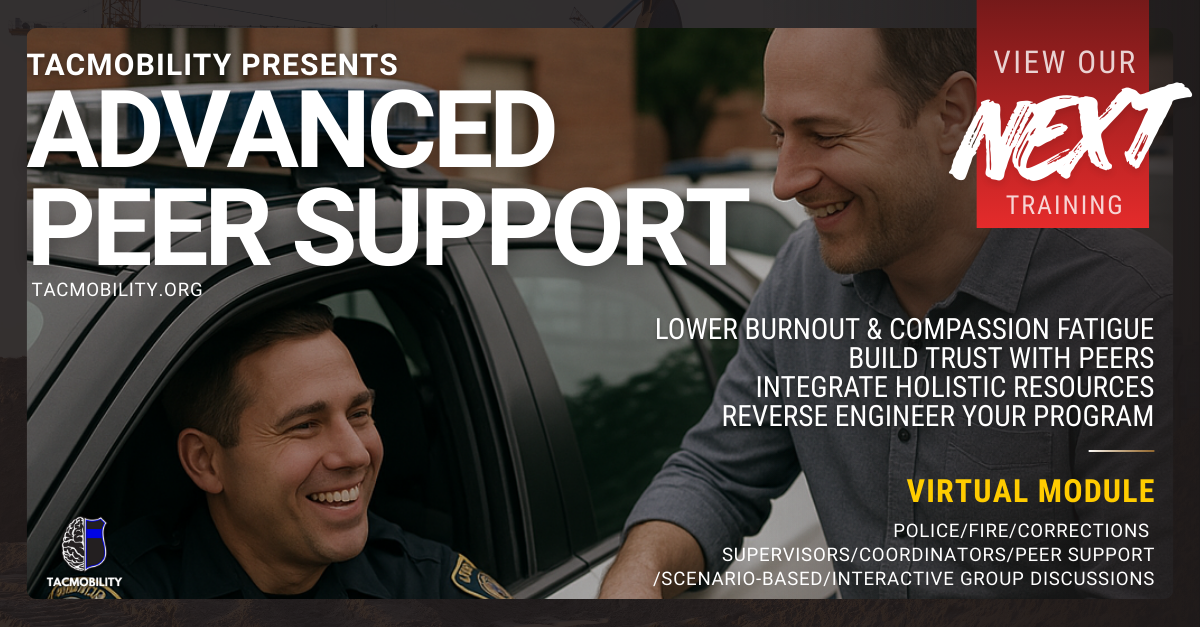
Comment “PLAYBOOK” to level up your leadership on March 18th.
The Advanced Peer Support Playbook is a virtual module designed for supervisors who understand that supporting their people is the mission—and that leadership standards matter more than uniform standards ever will.
Written by Erics Gaines
Erica is the CEO/Founder of TacMobility. She has been teaching law enforcement wellness programs since 2019. She has worked with over 3,000 officers across her career. Erica is a certified yoga instructor, IADLEST certified instructor and currently enrolled in a sociology program at Arizona State University.
Join us on Instagram!